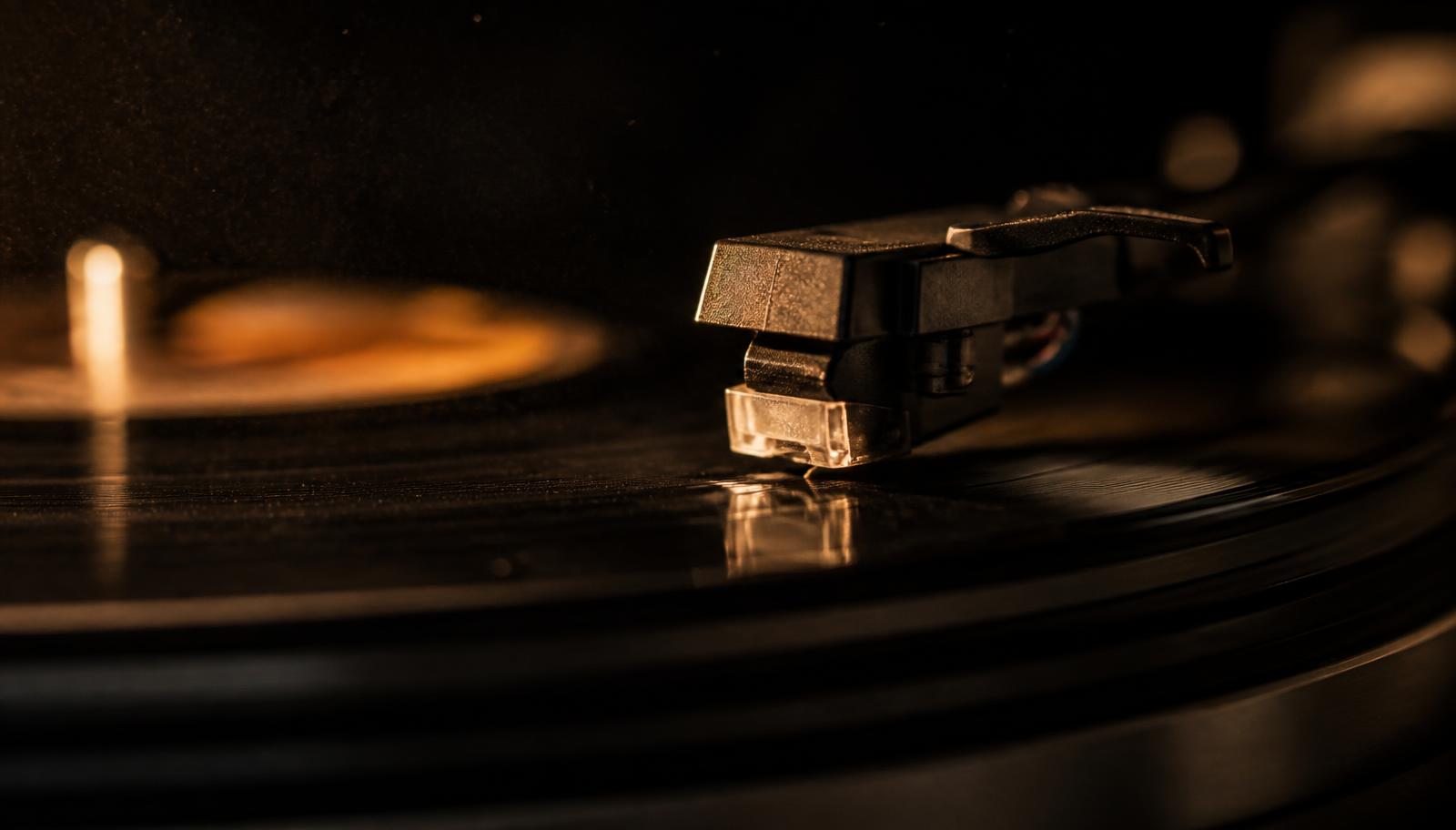
TL;DR: A vinyl record played on a properly set-up turntable with a clean, well-aligned stylus can be played hundreds of times, and usually well over a thousand, before you notice meaningful wear. The number is not fixed by the record. It is decided by your equipment and your habits. The record is rarely what fails: the stylus is, and a worn stylus can damage a record in a handful of plays. Keep the record clean, keep the stylus fresh and correctly set, and a record will comfortably outlive most of the gear you play it on.
The honest number
You will see wildly different figures quoted, anywhere from 25 plays to 5,000. Both ends of that range are real, which is exactly why the question is so hard to answer with a single number. The 25-play figure comes from worst-case conditions: a blunt, chipped or badly worn stylus dragged through an unclean groove at a tracking force nobody measured. The 5,000-play figure comes from laboratory-grade conditions, a fresh line-contact stylus, correct alignment, a clean disc and a record that is stored flat and handled by the edges. Everything most people experience sits between those two extremes, and where you sit is almost entirely your choice.
The important shift in thinking is this: play count is a property of the setup, not a property of the record. Two identical pressings, one played on a well-maintained deck and one played on a neglected all-in-one suitcase player, will diverge dramatically within a year. The vinyl compound itself is remarkably durable. It is a soft plastic, but the forces involved are tiny when the geometry is right. What destroys grooves is not the act of playing, it is playing badly.
Under good conditions, most collectors and manufacturers agree a record survives several hundred plays with only minor, often inaudible degradation, and a carefully maintained disc reaches well into four figures. Under bad conditions, that same record can be permanently scarred almost immediately, sometimes on the very first play. Nothing about the pressing changes between those two outcomes.
It is also worth separating two things that get conflated: wear and damage. Wear is the slow, cumulative reshaping of the groove wall by thousands of passes of a stylus, and it is what the play-count question is really about. Damage is a single event, a scratch, a dropped arm, a fingerprint that dries into the groove, and it happens in one second regardless of how many plays the record has had. Most records that people describe as "worn out" have actually been damaged, often by a single bad play on bad equipment. That is encouraging, because damage is far easier to avoid than to reverse.
What actually wears a record out
Groove wear happens when the stylus scrapes rather than glides. A correctly shaped, correctly loaded stylus rides the groove walls and traces them. A worn or wrongly loaded one ploughs. There are five causes worth knowing, roughly in order of how much damage they do.
A worn stylus, first and foremost
This is the single biggest cause of permanent damage, and the one most people ignore because it is invisible. A diamond tip does not fail suddenly. It wears flat on the contact faces, and those flats develop sharp edges. A sharp-edged flat presses into the groove wall with far more concentrated pressure than a smoothly polished tip, and it cuts. By the time a worn stylus sounds obviously bad, it has usually been damaging records for weeks. This is why replacement is done on hours played rather than on how it sounds. Our guide to how often to replace a turntable stylus covers the intervals for each tip profile and the signs you have left it too long.
Tracking force, too high or too low
Both directions cause wear, which surprises people. Too much force presses the stylus harder into the groove and accelerates mechanical wear on both diamond and vinyl. Too little is arguably worse: an under-weighted stylus loses contact with the groove wall on loud passages, chatters, and hammers the wall each time it lands. Mistracking distortion is the sound of a stylus bouncing off the very surface it is meant to be reading. Set the force to the cartridge maker's specification, in the middle of the stated range, using an inexpensive digital scale rather than the dial on the counterweight.
Dirt as an abrasive
A speck of grit under the stylus acts like sandpaper. It is trapped between diamond and vinyl under real pressure, and it grinds damage into the groove wall with every rotation, on both the record you are playing and every record you play afterwards until it falls off. Dust is not cosmetic. It is the mechanism by which most casual collections quietly degrade. A clean record played with a clean stylus is a completely different physical event to a dusty one.
Poor alignment and anti-skate
If the cartridge is not aligned to the correct geometry, the stylus sits at an angle in the groove and wears one wall harder than the other. Anti-skate does the same job dynamically: without it, the arm pulls inward, loading the inner groove wall. The audible result is often channel imbalance or distortion on one side only, and the physical result is asymmetric groove wear that no cleaning will undo.
Storage, heat and warps
Records stored leaning, stacked flat under weight, or anywhere warm will warp. A warped record forces the arm to move vertically through every rotation, which modulates tracking force continuously and makes clean tracing impossible. Sleeves matter too: a record returned to a paper inner sleeve collects paper dust that goes straight into the groove next time. Our seven storage mistakes that damage records covers the practical side in detail.
How to make your records last
Prevention is cheap and the habits are small. Four of them do almost all the work.
Replace the stylus on a schedule. Typically every 500 to 1,000 hours for a conical or elliptical tip, longer for line-contact profiles. Keep a rough note of hours rather than trusting your ears, because the deterioration is gradual enough that you will adapt to it.
Measure the tracking force. A digital stylus scale costs very little and removes the guesswork permanently. Check it again whenever you change cartridge, move the deck, or notice the arm behaving differently.
Clean before every play, and deep clean periodically. A carbon-fibre brush before each side removes loose dust. A wet clean or an ultrasonic clean removes what the brush cannot: mould release compound on new records, and years of embedded grime on older ones. Clean the stylus too, gently and from back to front. Our vinyl care guide walks through the full routine.
Handle and store sensibly. Edges and label only, back in an anti-static inner sleeve straight after play, stored vertically and snugly, away from radiators and sunlight. Let a record rest rather than replaying the same track back to back many times in one session, because friction warms the vinyl slightly and warm vinyl deforms more easily.
Do those four things and wear stops being something you need to think about for decades.
None of this requires expensive equipment. A brush, a stylus scale, decent inner sleeves and a replacement stylus on time will preserve a collection better than a far more costly turntable used carelessly. The gap between a well-treated record and a neglected one is measured in hundreds of plays, and almost all of it comes down to habits that take seconds.
How to recognise wear, in order
Wear does not arrive all at once. It announces itself in a predictable sequence, and knowing the order lets you catch it early enough to act.
First: sibilance. The "s" sounds in vocals start to spit or splash. This is the earliest audible symptom because those high-frequency, high-amplitude excursions are the hardest thing in the groove for a stylus to trace, and the first detail to be damaged.
Second: loss of top end. Cymbals lose their shimmer, the sense of air and space around instruments closes in, and the record simply sounds duller than you remember. This one creeps up slowly and is easy to attribute to mood or system rather than to the disc.
Third: distortion on loud passages. Choruses, brass stabs and anything heavily modulated start to break up and harden. At this stage the groove wall geometry has genuinely changed.
Fourth: noise that survives cleaning. A persistent gritty rustle in the same place every time, which a proper wet clean does not remove, is groove damage rather than dirt. That distinction is the test: dirt comes off, wear does not.
Inner tracks show all of this first. Groove velocity is lowest at the inner radius, so the same musical information is squeezed into a shorter length of groove and the stylus has to trace tighter curves at lower speed. If a record sounds fine at the start of a side and rough by the last track, that is inner-groove behaviour and it tells you either the stylus or the alignment needs attention.
What this means when you are buying
Here is the awkward part of second-hand vinyl: play count is invisible. You cannot see how many times a record has been played, and you cannot see it in a photograph either. A disc that has been played 800 times on a worn stylus and a disc played twice can look nearly identical under a phone camera. Light reflects off the surface, not off the geometry of the groove wall where the wear actually lives.
That is why grading standards matter more than photographs. A grade given by someone who plays and inspects the record under proper light, using a consistent published scale, tells you far more than any listing image. If you buy used anywhere, learn the scale first: our vinyl grading guide from Mint to Poor explains exactly what each grade should mean and where sellers most often overstate.
At VinylVault the question does not arise. Everything we sell is new and sealed. We buy collections, but we do not sell used stock, so every record that leaves us has a play count of zero and the entire lifespan described above still ahead of it. If you want to build a collection without paying new-release prices, the honest route with us is our cheaper new vinyl rather than gambling on someone else's play history.