

Slow-Motion Soul: The Accidental Birth of Monterrey's Cumbia Rebajada
![[HERO] Slow-Motion Soul: The Accidental Birth of Monterrey's Cumbia Rebajada](https://cdn.marblism.com/OaRj21RwVAU.webp)
If you've spent any time digging through crates of vinyl records, you know that the best finds are often the ones you weren't looking for. Sometimes, the needle drops and a sound comes out that completely shifts your perspective. But in Monterrey, Mexico, the birth of an entire subculture didn't happen because someone found a rare record: it happened because a record player literally started to die.
Welcome to the world of Cumbia Rebajada. It is a genre defined by heavy bass, stretched-out accordion notes, and a tempo so slow it feels like the music is wading through honey. It's "low and slow" personified. And like all the best things in music history, it was a total accident.
The Motor That Changed Everything
The story starts with a man named Gabriel Dueñez. In the 1960s and 70s, Dueñez was a sonidero: a neighborhood DJ who would set up massive sound systems (known as sonidos) to play music for the community. In Monterrey, the music of choice wasn't necessarily Mexican pop; it was Colombian Cumbia and Vallenato.
During one particularly legendary neighborhood party, Dueñez's Rapson sound system: a beast of a machine that had been running for six or seven hours straight: decided it had had enough. The motor began to overheat. As the heat rose, the power dragged, and the turntable started to spin slower. And slower. And slower.
In any other context, a DJ would scramble to fix the gear or apologize for the technical glitch. But as the pitch of the Colombian Cumbia dropped and the rhythm decelerated, something strange happened. Nobody stopped dancing. In fact, they started dancing better.
The voices on the track deepened into a ghostly, soulful growl. The accordion notes, usually bright and frantic, stretched into long, emotional wails. The space between the scrape of the guiro became a cavernous groove. This was the birth of the rebajada, literally, "the lowered" or "the slowed down."

The Soul in the Slowness
Why did it work? To understand that, you have to understand the heat and the hustle of Monterrey. This is an industrial city, a place of hard work and high temperatures. When the music slowed down, it matched the pace of the streets. It gave the dancers room to breathe.
Cumbia Rebajada isn't just about playing a record at the wrong speed; it's about finding the "soul" hidden inside the grooves. When you slow down a high-energy Cumbia track, you strip away the frantic party atmosphere and reveal a deep, melancholic core. It's what we at Vinyl Vault like to call "Slow-Motion Soul." It's the same reason people love Ambient or deep Dub: it's about the vibration and the feeling, not the BPM.
Dueñez realized he was onto something. He didn't fix the motor immediately. Instead, he began intentionally recording these slowed-down versions onto cassettes. He would take his rare vinyl collection, run it through his struggling equipment, and capture the magic.
Puente del Papa: The Vinyl Ground Zero
You can't talk about Monterrey's Cumbia obsession without talking about the "Puente del Papa." This bridge, connecting the Independencia neighborhood with downtown, became the spiritual home of the city's vinyl trade. It was a massive open-air flea market where you could find anything, but for the musicados, it was all about the Colombian imports.
In the 60s and 70s, Monterrey became a hub for World music before that was even a marketing term. Colombian immigrants and travelers brought over stacks of 45s and LPs that weren't available anywhere else in Mexico. If you wanted to buy vinyl records that could make a crowd move, you went to the bridge.
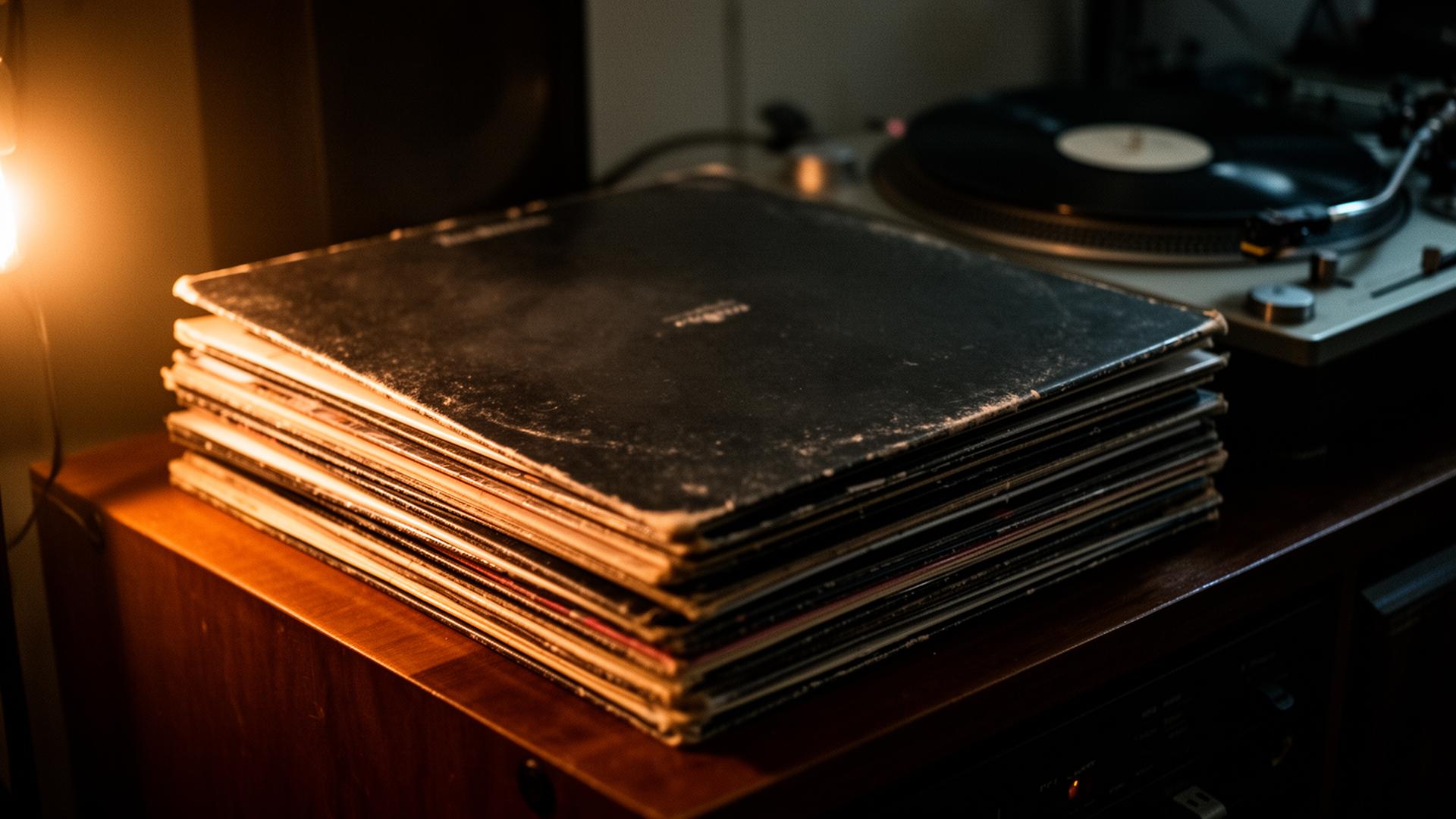
The sonideros were the ultimate gatekeepers. They would often scratch out the labels on their records so rival DJs couldn't see what they were playing. They hunted for "hits" that nobody else had. This culture of secrecy and exclusivity created a massive demand for rare vinyl. To this day, collectors still scour second-hand vinyl shops looking for those specific pressings that sound just right when you drop the pitch by 20%.

The Kolombianos: A Subculture of Their Own
As the rebajada sound grew, so did the community around it. Enter the Kolombianos (or Cholombianos). This was a youth subculture, primarily from the working-class hills of Monterrey, who adopted Colombian Cumbia as their own.
They weren't just fans; they were a movement. With their distinctive oversized clothing, intricate religious jewelry, and iconic "slicked-down" hairstyles with long sideburns, they were impossible to miss. They formed "dance crews" and would spend their weekends at sonidero parties, circling up to show off their moves to the slowed-down beats of Gabriel Dueñez and his contemporaries.
For the Kolombianos, Cumbia Rebajada was a form of resistance. In a city that often looked down on the working-class residents of neighborhoods like Colonia Independencia, the music was a badge of identity. It was a way to say, "We have our own rhythm, and it doesn't move at your speed."
Celso Piña: The Rebel of the Accordion
While the sonideros were spinning the records, one man was busy bringing that sound to life on stage. Celso Piña, known as "El Rebelde del Acordeón" (The Rebel of the Accordion), is perhaps the most famous figure to emerge from this scene.
Born and raised in the heart of Monterrey's Independencia neighborhood, Piña took the soul of the rebajada and infused it into his live performances. He wasn't just playing Cumbia; he was playing Monterrey Cumbia. He understood the "drag" of the rhythm. By the time he collaborated with artists like King Krule or Toy Selectah later in his career, the world finally began to see what Monterrey had known for decades: this music is universal.
If you're looking to understand the roots of this sound, you need to hear Piña's early work. It's got that raw, dusty energy that you only get from a well-loved piece of Soul or R&B vinyl.

Why Vinyl Still Matters for Rebajada
In a world of digital controllers and pitch-shift plugins, you might wonder why vinyl records are still the gold standard for the rebajada sound. The answer is simple: texture.
When you slow down a digital file, the software tries to "fill in the gaps," often resulting in a clean, clinical sound. But when you slow down a physical piece of vinyl, you are literally stretching the analog waves. You're hearing the grit, the hiss of the needle, and the physical weight of the bass. The "imperfections" become the highlights.
At Vinyl Vault, we always tell people that if you want to experiment with sound, start with the physical. Whether you're into Techno or Hip-Hop, there is something incredibly tactile about manipulating a record. The sonideros of Monterrey weren't just DJs; they were early sound hackers. They took a medium and pushed it past its intended limits to create something entirely new.
The Legacy of the Slow-Down
Today, the influence of Cumbia Rebajada can be heard everywhere. From the "chopped and screwed" hip-hop of Houston to the slow-burning Experimental tracks coming out of clubs in Berlin and London, the idea that "slower is better" has become a staple of modern music production.
But for the people of Monterrey, it's more than a production trick. It's a history of a city, a neighborhood, and a mechanical failure that turned into a masterpiece. It reminds us that sometimes, the best thing you can do is slow down and listen to what the record is really trying to tell you.
Next time you're browsing our collections, maybe skip the high-energy bangers for a second. Look for something with a bit of "drag." Look for that record that feels like a humid night on a bridge in Mexico.

Start Your Own Sonic Experiment
Whether you're looking to score some cheap vinyl records to practice your own pitch-shifting or you're on the hunt for a specific Disco or Funk rarity, we've got you covered. The spirit of the sonidero is all about discovery and sharing the music that moves you: even if it moves you at 33 RPM instead of 45.
Ready to find your next favorite spin?
Don't wait for your equipment to overheat to find a new sound. Start digging today. After all, the best stories in music are usually hidden in the grooves of a record someone else almost threw away. Period.